

A Parent's honest Guide To infant surivial swim lessons
Infant Survival Swim Lessons: What Parents Should Know Before Starting

A Parent's honest Guide To infant Survival swim lessons
Infant Survival Swim Lessons: What Parents Should Know Before Starting
If you're searching for infant survival swim lessons, you probably already know why.
Something made water safety feel urgent.
Maybe it was a video online. A close call. A new pool in the neighborhood. Or just that gut feeling every parent gets when their toddler starts moving faster than expected.
Whatever brought you here… you're asking the right question.
But here's what most parents don't find out until it's too late: Not all infant survival swim lessons are actually teaching your child to survive.
Some are glorified splash sessions. Some put four kids with one instructor and call it a swim class - charging $30 a week for a year while your child still can't float on their own.
And even within survival swim… not all programs are equal.
Some use outdated methods. Some instructors are harsh. One Instructor actually yelled at my one-year-old for not doing a skill correctly.... true story.
Others have no real certification behind them at all.
The wrong program doesn't just waste time and money. And it can leave your child scared of the water.
Who teaches it, how they're trained, and how they treat your child matters just as much as the method.
This guide covers all of it. Let's get into it…
Quick Summary
Traditional swim classes are not survival swim. They teach water comfort, not water safety. There's a big difference.
Not all survival swim programs are equal. Instructor training, teaching philosophy, and how they treat your child matter just as much as the method itself.
Most kids develop real survival skills in 7 weeks or less.
Crying during lessons is normal. It doesn't mean something is wrong. It means your child is learning something new.
Floaties are not a safety plan. Most drownings happen when no one is swimming - not during pool time.
The Infant Aquatics® method is more modern, more play-based, and more effective than what you've seen in those scary videos online.
Keep reading. This one's worth your time.
What Are Infant Survival Swim Lessons - And Why Do They Matter?
This isn't a normal swim class.
It's survival first.
Infant survival swim lessons teach babies and toddlers what to do if they end up in the water unexpectedly. Not how to kick on a kickboard. Not how to blow bubbles. Not how to splash around with a floaty.
We're talking about real skills. What to do when something goes wrong.
Rolling to their back. Floating independently. Breathing. Getting to a wall. Getting out.
Skills that work when no one is watching.
At their core, survival swim programs teach one simple, repeatable sequence: Swim. Float. Swim.
Your child swims, rolls to their back for a breath, then keeps going. Over and over. Until it's automatic.
That sequence is what saves lives.
But only if the lessons are actually teaching survival skills.
That's the part most parents don't realize until they've already spent a year in the wrong program.
What Happens After Survival Skills Are Mastered?
Here's something most programs don't talk about - and it matters.
A good survival swim program doesn't stop at survival.
Once your child has those core skills locked in - once you have real peace of mind near the water - lessons shift toward actual swimming. Pre-strokes. Technique. Building confidence in the water.
There's a difference between a program that maintains your child's skills and one that keeps building on them.
We call those progression lessons. Not maintenance. Not the same skill on repeat. Actual forward progress - toward a child who doesn't just survive in the water, but thrives in it.
And that peace of mind? It changes everything.
You stop holding your breath every time you're near a pool. Your child stops being someone you have to watch every single second - and starts being the kid everyone else is watching because they’re amazed.
That's the goal.
Why Regular Swim Classes Aren't the Same as Infant Survival Swim Lessons
Let me be honest with you.
If your child is in a group swim class at a big swim school - and you're looking for infant survival swim lessons... there's something important you need to know.
They're learning to enjoy the water.
That's not nothing. But it's not safety.
Here's what a typical group class looks like for a baby or toddler:
Your child gets to the pool. There are three or four other kids. The instructor cycles through each one. Your baby might get 5 to 7 minutes of actual one-on-one time. The rest of the lesson? Sitting on the step. Waiting.
The instructors at a lot of these schools are genuinely good people. But they're often college students or part-time staff - not specialists in breath control, self-rescue, or infant development.
And the format makes it almost impossible to build real survival skills. Once a week isn't enough. Group settings aren't focused enough. The curriculum isn't designed for it.
What These Classes Actually Teach - And Why It's Dangerous
Here's the part that worries me most.
A lot of group infant classes teach babies to blow bubbles underwater.
That sounds harmless. But blowing bubbles is the opposite of what a child needs in a real emergency.
In a real emergency, your child needs to hold air in. To float. To breathe.
Blowing it all out creates a habit that works directly against survival. That one habit could cost them.
On top of that, most traditional classes keep babies vertical in the water - bouncing, splashing, holding on. Vertical is the natural drowning position. No horizontal body positioning. No floating. No self-rescue.
So after a year (sometimes two) parents are often shocked to discover their child has no real survival ability at all.
We hear it all the time:
"We did swim lessons for over a year. She loved it. But I don't feel like she's actually learning anything."
That's not a failure of the child. That's a failure of the format.
The False Sense of Security Is the Real Danger
A child who's been in swim classes for a year feels comfortable around water.
Their parents feel comfortable too.
But if that child falls in unexpectedly - no floatie, no instructor, no parent within arm's reach - they don't have the skills to survive.
That comfort, without the skills to back it up, is actually more dangerous than a child who has never been near water at all.
What About Floaties and Puddle Jumpers?
Before I talk about floaties, I need to tell you something.
Because this isn't just my professional opinion. This is personal.
Our first two kids went through ISR with an incredible instructor. It worked. We believed in the program completely.
Then we moved to League City and started Jude (our third) with a new instructor close by.
He was nine months old.
And this instructor would yell at him. For crying. For not doing it right. For being a nine-month-old who was scared and confused in the water.
We finished the program. But we didn't go back.
Instead, we made the same decision a lot of parents make…
We chose floaties.
Not because we didn't know the risks. We did. But we also knew what the alternative looked like - and at that moment, floaties felt like the most reasonable answer while we figured out what to do next.
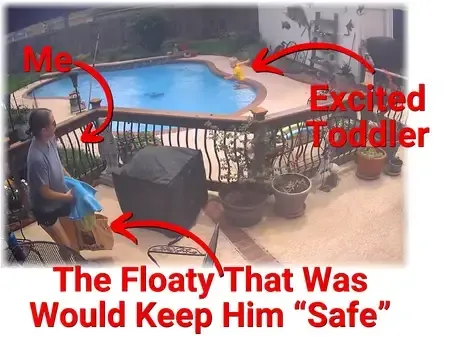
Then one afternoon, Jude got excited about going swimming and ran toward my in-law's pool.
I was outside with our stuff. Floaties in hand. Hadn't even set my bag down yet.
By the time I turned around, he was already in the air - huge smile on his face.
The security camera caught it. Me still holding the floaties. Him already mid-air.
I got to him. I was right there.
But that moment is the reason I became a certified instructor.
And if I'm being honest… it's the reason I'm writing this article.
Because what happened to us happens every single day. And most of the time, there isn't a parent standing right there.
Drowning is the number one cause of accidental death in children under 4 and it happens fast. But that statistic doesn't include the close calls. The moments like ours that never make it into the data.
Floaties feel like safety… But here's what they actually do:
They keep kids vertical in the water. Vertical is the drowning position.
They teach children that they need a device to stay safe. So when that device isn't there (and one day it won't be) they have nothing to fall back on.
Most drowning incidents involving young children don't happen during supervised swim time. They happen when a child slips away at a cookout. When a gate gets left open. When a toddler moves faster than anyone expected.
In those moments, the floaties are hanging on a hook by the back door.
They're not a safety plan. They never were.
So What About Survival Swim Programs? Aren't They All the Same?
This is where I want to be really honest with you.
Survival swim is the right category. I believe in it deeply - it's what I've dedicated my career to.
But not all survival swim programs are the same.
And some of the differences matter a lot.
The Outdated Approach - What You've Probably Seen in Those Scary Videos
If you've spent any time searching survival swim online, you've probably seen videos that made you uncomfortable.
A baby being dunked. A toddler screaming. An instructor with a no-nonsense, get-it-done approach that looks more like a drill than a lesson.
Parents have described children who clung to them for weeks after lessons. Kids who developed real anxiety around water. Children who finished the program with the skill… but hated swimming.
That's a real problem.
Some older survival swim approaches are built around repetition and pressure. Push the skill. Repeat it. Move on. There's not much room for a child who needs more time to trust the water. Or the instructor. Or the process.
There's no play. No connection. No reading the child in front of you.
Just results… at whatever cost.
And I get it. The skill is real. The method works in the narrow sense that children do learn to float.
But a child who survives the program and ends up terrified of the water hasn't really won. And neither have you.
The Uncertified Programs - A Risk Most Parents Don't Know About
Here's something that surprises a lot of parents:
Anyone can call their lessons survival swim.
There's no universal licensing requirement. No certification required by law. Nothing stopping someone from watching a few videos and setting up shop.
That means the person teaching your baby to hold their breath underwater might have very little actual training in infant development, breath control, anatomy, or safe submersion techniques.
A professional-looking website and a few good photos don't tell you how someone was trained. Or if they were trained at all.
Before you hand your child to any instructor, ask how they were certified, who trained them, and how many hours they spent in the water before teaching on their own.
If they can't answer that clearly and confidently... keep looking.
What to Look For When Choosing Infant Survival Swim Lessons
Before you sign your child up anywhere, ask these questions:
What certification do you hold - and who trained you?
How many hours of in-water training did you complete?
How do you handle a child who is anxious or resistant?
What does the first lesson look like?
Do you have experience teaching children with special needs?
If an instructor can't answer those questions clearly and confidently - keep looking.
What Makes the Infant Aquatics® Method Different
I'm an Infant Aquatics® certified instructor. And I want to explain what that actually means - because it's not just a logo on a website.
The Infant Aquatics® training program is one of the most comprehensive in the industry. Instructors complete over 100 hours of hands-on, in-water training. We study child development, anatomy, physiology, emotional regulation, and how to read nonverbal cues in infants and toddlers.
We also have access to a nurse on staff - something most programs simply don't offer.
But beyond the credentials, it's the philosophy that sets this method apart.
Play-Based Teaching - It's Not Just Fun. It's How Kids Actually Learn.
Little kids don't learn through drills.
They learn through play.
Every skill I teach is wrapped in something that feels like a game. Rings. Relays. Hide and seek at the pool steps. Peekaboo at the water's edge.
One parent told me she thought the rings were just for fun. She had no idea each game was building breath control, floating mechanics, and body awareness at the same time.
That's the point.
When a child is playing, their nervous system is calm. When their nervous system is calm, they learn faster. They retain more. They come back the next day ready (and excited) to go again.
Compare that to a lesson built around pushing through resistance. A child who spends half the session upset and overwhelmed isn't learning efficiently. And they're building a negative association with water that can take years to undo.
Play isn't a reward at the end of a hard lesson. It's the whole method.
Trust-Building Is Part of the Curriculum
I don't just teach swim skills.
I teach trust.
With a nervous child, my first goal isn't to get them in the water. It's to make them feel safe with me. We play on the pool deck. I use their favorite toys. I get on their level and figure out what makes them laugh.
Only when they're ready do we move into the water - and even then, we go at their pace.
An excited child gets a different approach. We channel that energy into safe habits - asking permission before getting in, learning how to enter properly, building the routines that keep them safe for life.
Every child is different. That's not a problem in my program. It's the whole design of it.
Modern Methods. Faster Results. Without the Trauma.
The Infant Aquatics® method is updated as our understanding of child development grows.
No one-size-fits-all approach. No forcing a child past their limit because the clock says it's time to move on. No yelling. No harsh repetition.
We use teaching strategies designed to help children learn faster - without the stress.
I can't share every specific (some of it is proprietary to the curriculum), but the results speak for themselves.
Most children who come through our program learn more in their first week than they did in a full year at a traditional swim school.
And unlike older survival swim approaches that call their follow-up sessions "maintenance" - because they're just repeating the same skill - our follow-up sessions are progression lessons. We build on what your child knows. They keep getting better.
That's a big difference.
What Age Should You Start Infant Survival Swim Lessons?
Earlier than you think.
At South Shore Infant Aquatics, I work with children starting at 6 months old.
Around 6 months, babies start to become mobile. They roll. They reach. They figure out how to get places their parents weren't expecting.
And once a child is mobile, the risk of an accidental water entry goes up dramatically.
months
months
months
months
years
years
Drowning is the #1 cause of accidental death in children under 4. The earlier you start, the more time skills have to become instincts.
You don't need a backyard pool for this to matter. A neighbor's pool. A splash pad. A lake on a camping trip. A bathtub left unattended for thirty seconds.
Water is everywhere.
Does Starting Earlier Really Make a Difference?
Yes.
Young babies are incredible learners. Their nervous systems are still forming habits. The patterns we build in early lessons become deeply ingrained - in their muscles, their instincts, their automatic responses.
A baby who starts at 6 months has survival reflexes built in long before they're independently mobile and exploring on their own.
A child who starts at 3 or 4 can absolutely learn - but they've spent years building other habits, developing opinions about the water, and sometimes accumulating fear from earlier experiences.
Earlier isn't always possible. But when it is - it matters.
What If You Don't Have a Pool?
If there's no pool in your immediate life, start around the time your child begins to walk or crawl.
The moment they can get somewhere on their own is the moment the risk goes up.
That's when I'd start.
What to Expect From Infant Survival Swim Lessons
How Long Does It Take?
Most children complete the program in 7 weeks or less.
Lessons are 10 minutes long, four days a week - Monday through Thursday.
I know that sounds like a big commitment. And it is. But here's why it works:
This is muscle memory.
Short, consistent, daily repetition is how the body and brain lock in new skills. A 10-minute lesson four days a week beats a 45-minute lesson once a week - every single time.
Children also never reach the point of overwhelm. Sessions end before frustration peaks. Which means they show up the next day with a fresh start.
What If My Child Needs More Time?
We keep going. For free.
If your child hasn't passed their survival skill checkouts by the end of the program, we add an extra week at no additional cost.
Some children finish in less than 7 weeks. When that happens, we turn the remaining lessons into free progression sessions - building new skills on top of the ones they've already mastered.
Either way, you're not paying more.
What Results Should Parents Expect?
For babies who aren't walking yet:
Your baby will learn to fall into the water, roll to their back, and float calmly - holding that position until help arrives. They practice this in regular clothes too. Because real emergencies don't happen in swimsuits.
For toddlers and preschoolers:
Your child will learn the swim-float-swim sequence - swimming through the water, rolling to their back for a breath, then continuing to swim. They'll learn to reach the wall, climb out independently, walk the pool edge safely, find the stairs, and ask permission before getting in every single time.
That last habit matters more than most parents realize. Asking before entering - every time, from the very beginning - is one of the most powerful safety tools we teach.
What About Crying?
Your child will probably cry. Especially in the first few days.
That doesn't mean something is wrong.
Crying is how little kids communicate. It means they're in a new situation with new sensations and a person they're still learning to trust. It's completely normal.
What you'll also notice - usually within the first week - is that the crying changes. It gets shorter. It starts later in the lesson. And then one day, your child walks to the pool edge and just... jumps in.
That transformation happens faster than most parents expect.
It's one of my favorite things to watch.
What Does Day One Actually Look Like?
Most parents are nervous before the first lesson. Honestly - I expect that.
Here's what actually happens.
If your child is nervous, we start slow. Favorite toys on the pool deck. A silly game. I get on their level, figure out what makes them smile, and let them set the pace. We move into the water when they're ready - not before.
If your child is excited and ready to jump in immediately, we channel that energy. Safe entry. Asking permission. Building the habits that will protect them for life.
By the end of the first lesson, most parents are surprised. Either because their nervous child did better than expected - or because they realized this feels completely different from anything they've seen before.
That's day one. It only gets better from there.
Real Stories From Real Families
Noah - The Text That Made My Day
One of my swim parents sent me this message after a family trip:
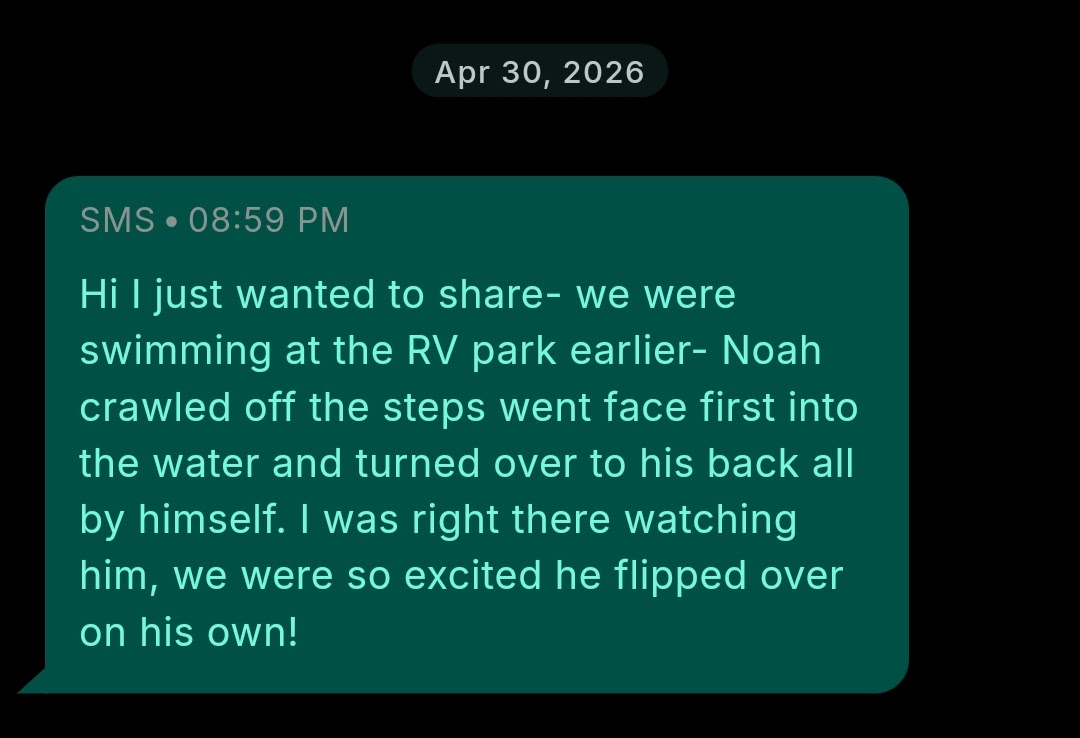
That's the whole point.
Not a controlled pool test. Not a graduation ceremony. A real moment, in a real situation, where a baby used a real skill to keep himself safe.
That's what we're building toward in every single lesson.
Carissa - Swimming With Cerebral Palsy
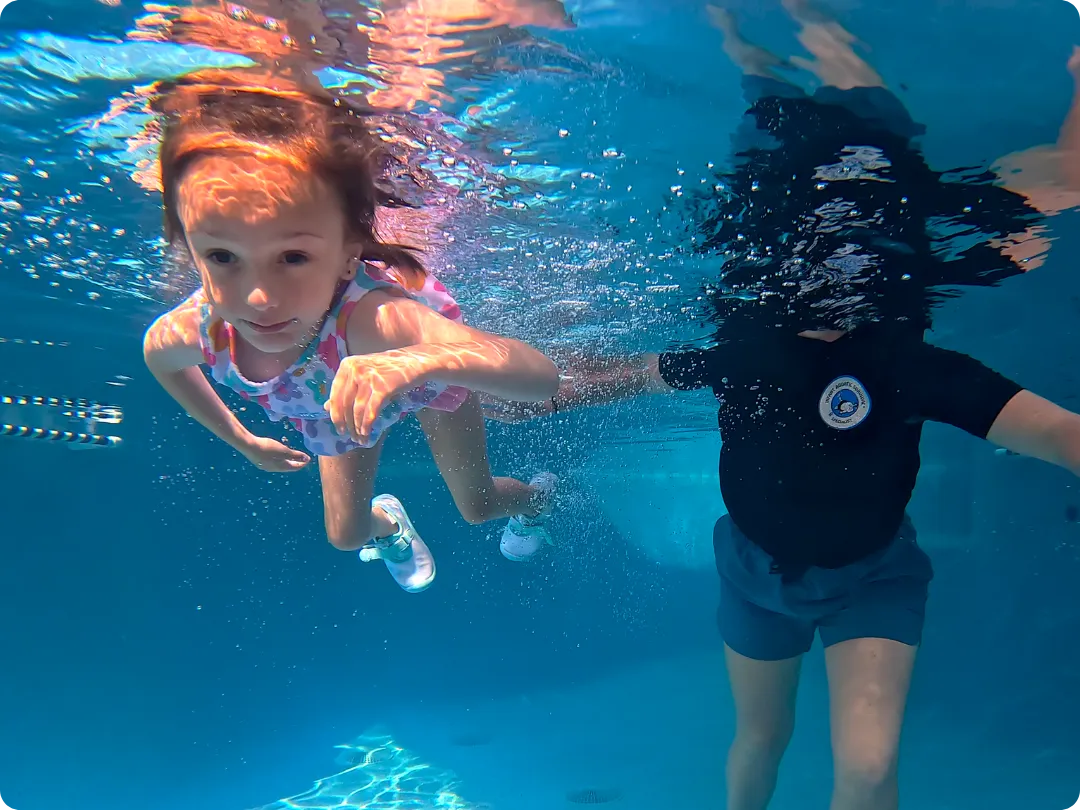
Carissa was 6 years old when she started lessons with me. She has cerebral palsy - low muscle tone in her core, mobility challenges, and significant anxiety around water. She cried almost every lesson at first.
I honestly wasn't sure how quickly she'd progress.
By the end of the program, Carissa was completing multiple independent swim-float-swim sequences.
She passed every survival skill checkout - including fully clothed assessments in summer, fall, and winter clothes.
Her mom cried. I might have too.
Carissa taught me that the method works for every child - when the instructor meets them where they are.
Tyler - From Clinging to Actually Swimming
Tyler is autistic. When we first started, he would hold on to me like his life depended on it - because in his mind, it did.
He was terrified.
Getting him to do the clothed swim checkout - full pants, shirt, jacket - felt almost impossible at first.
He did it.
Head down, actually swimming.
That kind of progress doesn't happen by pushing a child past their limit. It happens by building trust, going at their pace, and never giving up.
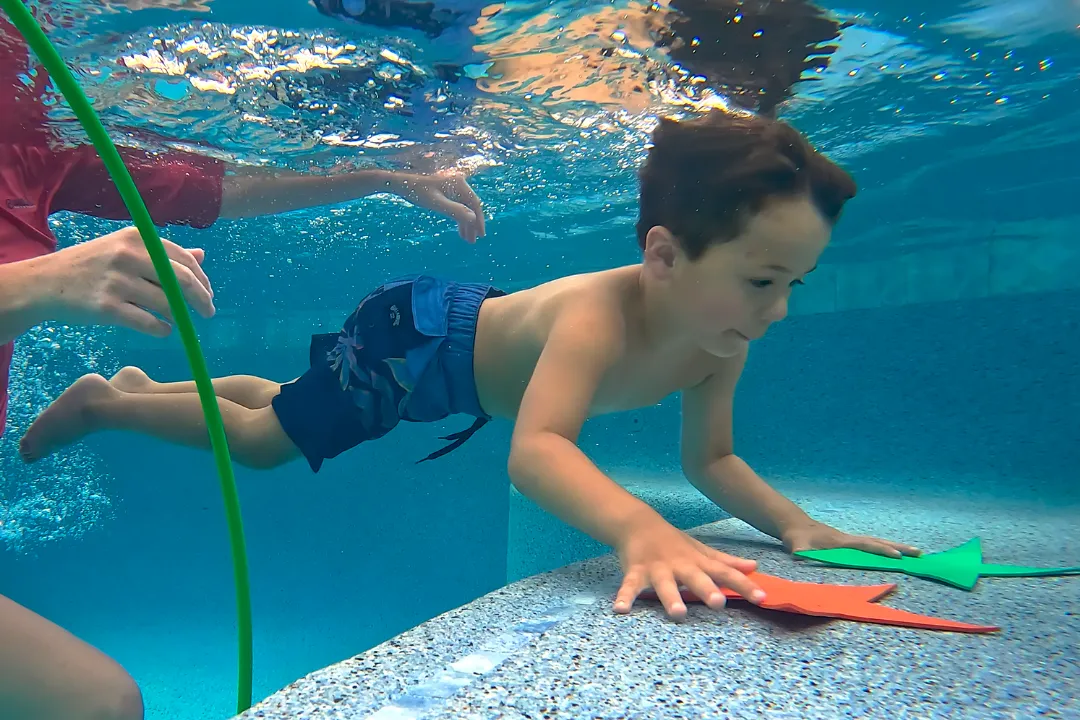
Beaux - From Big Fits to the Pool's Best Jumper
Beaux's dad used to bring him to lessons and Beaux would throw a full fit before even getting in.
He was scared. He didn't want to be there. His dad was patient. I was patient.
Now? Beaux is barely two years old and he jumps into the pool on his own like he owns the place.
He's one of the best swimmers I've ever taught.
That's what patience and connection do.
Common Questions Parents Ask Before Starting
Are infant survival swim lessons traumatizing?
Infant survival swim lessons, done correctly, are built around connection, consistency, and play.
The goal isn't to scare your child into learning. It's to build real skills through connection, consistency, and play. A child who finishes our program loves the water - they don't fear it.
My child already did traditional swim lessons for a year. Is it too late?
No. But we may need to undo some habits first.
Traditional lessons sometimes teach children to blow bubbles, stay vertical, and rely on an instructor's hands. We retrain those patterns gently. Most families see more progress in their first week with us than they did in a full year elsewhere.
What if my child has special needs?
That's something I specialize in. My Swim Angelfish® certification was designed specifically for teaching children with autism, cerebral palsy, Down syndrome, sensory differences, and more.
I've never had a child I couldn't reach. It just takes the right approach.
Can I be there during lessons?
Yes - you'll watch from poolside. For the first lesson or two, and again near the end of the program, you'll be in the water to learn how to support your child's skills at home.
What happens after the program ends?
Bodies change. What worked at ten months needs a refresh at eighteen. Skills don't stay sharp on their own.
Your child can enroll in our Otter Squad Progression Program - weekly lessons that build on their survival skills and keep developing real technique as they grow.
South Shore Infant Aquatics - Our Program in League City, TX
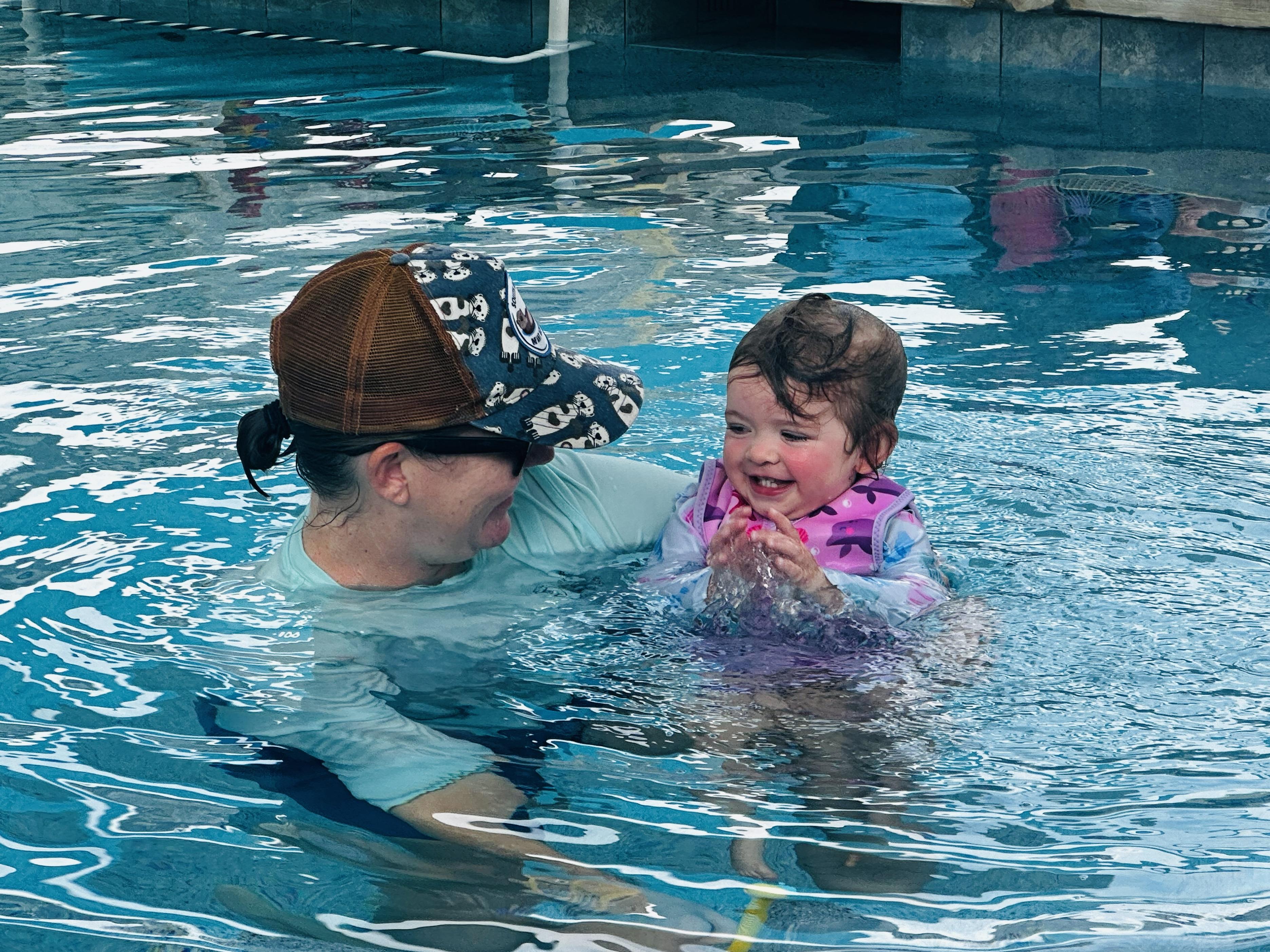
I'm Candice, and I teach infant survival swim lessons in League City, Texas - at Marina Bay Park, near South Shore Blvd and Compass Rose.
I started South Shore Infant Aquatics because I couldn't find a program I trusted for my own kids.
I know how that sounds coming from a swim instructor.
But the programs available to us at the time weren't teaching the way I believed children should be taught.
So I went and got trained myself - and I haven't looked back.
My Training and Certifications
I hold certifications from two of the most respected programs in the industry:
Infant Aquatics® - one of the most comprehensive infant survival swim training programs available, covering child development, anatomy, breath control, emotional regulation, and hands-on in-water instruction.
Swim Angelfish® - a specialized certification for teaching children with autism, cerebral palsy, Down syndrome, sensory processing differences, and other special needs.
I also hold a degree in education and spent years as an elementary music teacher before becoming a swim instructor. That background shapes everything about how I teach - the games, the songs, the patience, the ability to read a room full of tiny humans and figure out what each one needs.
What Makes Our Program Different
One-on-one instruction. Every lesson. Every child.
No groups. No waiting on the side of the pool. Every minute of every session is focused entirely on your child.
Play-based teaching that builds skills faster - because children learn best when they feel safe and they're having fun.
A flat fee. No weekly billing that drags out longer than it needs to.
A 7-week guarantee. If your child isn't where they need to be, we keep going for free.
Progression lessons after completion - not maintenance. Your child keeps getting better.
A nurse on staff available for medical questions - something most programs simply don't have.
Who We Teach
We work with children starting at 6 months through 6 years old for our survival swim program.
Children 7 and up are welcome in our Otter Strong program - traditional stroke development built on a real survival swim foundation.
We also specialize in children with special needs through our adaptive aquatics program.
If your child has been told they "can't" learn to swim - I'd love to talk.
The Biggest Mistake Most Parents Make
Waiting.
That's it.
Not choosing the wrong program. Not worrying about the cost. Not overthinking the schedule.
The biggest mistake is deciding to start "later" - when the child is older, when the timing is better, when it feels less scary.
Water doesn't wait.
The risk goes up the moment your child becomes mobile. And the skills that take 7 weeks to build today might take much longer - and be much harder - to build later.
Most parents who go through our program say the same thing when it's over:
"I wish we had started sooner."
Don't be that parent.
Ready to Get Started?
If you're in the League City area, and looking for infant survival swim lessons, I'd love to work with your child.
Our program fills up quickly - we keep our schedule intentionally small so every child gets the attention they deserve.
Not in League City, TX? The Infant Aquatics® network has certified instructors across the country.
Ready for your children to become confident swimmers?

LOCATION: LEAGUE CITY, TX
We are located in Marina Bay Park (near Ferguson Elementary). The closest intersection would be South Shore Blvd and Compass Rose.


Swimming Lessons are not a replacement for active supervision. For more information on "layers of protection" and water safety please visit National Drowning Protection Alliance and Pool Safely. No one can "drown-proof" a child.
By pressing "Continue To Next Step" you consent for Counterpoint Industries, LLC and its authorized vendors to contact you at the telephone number provided for marketing purposes, with the use of technology that may include automatic dialing or prerecorded technology. Msg & Data Rates May Apply. Text back STOP at any time to opt-out. Consent is not required to make a purchase.
INFANT AQUATICS®, INFANT AQUATIC SURVIVAL®, Swim Float Swim® and the ‘Baby Logo’® are trademarks owned by Infant Aquatics, LLC, Boulder Colorado, and used under license. All rights reserved. Used with permission.
Swim Angelfish®, Swim Whisperers®, and Swim Whisperers® are registered trademarks owned by Swim Angelfish LLC, based in Connecticut, and licensed to Counterpoint Industries, LLC. All rights reserved.
© Counterpoint Industries, LLC 2025 | All Rights Reserved | Terms of Use & Privacy Policy
* South Shore Infant Aquatics is not affiliated with or endorsed by Infant Swimming Resource (ISR). ISR is a registered trademark of Infant Swimming Resource, LLC. While our program was developed by a former ISR instructor, Infant Aquatics is a separate and independent program with its own methodology, curriculum, and approach.